Mostrando entradas con la etiqueta Monuments. Mostrar todas las entradas

domingo, 25 de noviembre de 2012


DRESDEN, POSSIBLY THE CITY MORE BEAUTIFUL OF GERMANY

Dresden is the capital of Saxony, right in the Centre of Europe, with more ¹⁄₂ million habitants. Its importance comes to become habitual residence of the ruler of SaxonyD.
The find is at a crossroads, Dresden was one of the cities worst hit by the wars that took place in Europe. But it was World War II that left her completely in ruins.
The river Elbe divides the city into two parts. The historical centre of Dresden, protected by an extensive fortification is located on the left bank. The most important buildings are the Church Frauenkirche, the Museum of the city (Zwinger), the Palace of the Opera Gottfried Semper, the Royal Palace, the Cathedral of Dresden.
Life of Dresden party's Altmarkt square, it`s celebrated in the traditional Christmas market, Dresden.
The Grober Garten Park, is the busiest of the city, place of concerts and outdoor activities...

For all these reasons and while Dresden is a city that still continue rebuilding its terrible past, we can affirm, with security that is one of the most beautiful cities in Germany...

viernes, 23 de noviembre de 2012

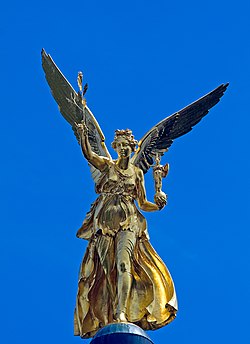
Angel of Peace


The Angel of Peace is a monument in Munich.

The angel is a reminder of the 25 paceful years after the Franco-Geman war in 1870-1871. In the hall of the temple are gold mosaics.

The sculpture was made of molten bronze and covered of gold, there was a job maked by Heinrich Düll, Georg Pezold y Max Heilmaie famous german artists.


The first stone was laid on 10 May 1896; they finished it on 16 July 1899.

When the Angel fell from the column in 1981, lots of damages could be repared. After having the accident, the angel was put back on this column in 1983. Their legs and wingss could be repared too.

miércoles, 21 de noviembre de 2012

The Neptune Fountain


The Neptune Fountain in Berlin was built and designed by Reinhold Begas. The Roman god Neptune is in the centre. This fountain is in a pank between St Mary's Church and the “red council”.

The fountain was a present by the city to Guillermo the second. The fon¡untain was inaugurated first of november in 1891. At the beginningi was know like Begasbrunnen (Begas fountain) because Reinhold Begas built and designed the sculpture.

The sculpture broke during the World war II, them were saved during a time.
But today we don’t know if the fountain is in his correct place.


                                                                 The Neptune Fountain


In the centre of the fountain is Neptune, the oceans god.In his shoulder and take of his hand we can see his famous trident.And his other hand is on his leg. Neptune is on a shell with some newts. And surrounded of a lot of kids plying with water.


In the fountain there are lots of animals like turtles, crocodiles, seals, etc.In the edge of the fountain there are four female humans that represents the Rin, Vístula, Óder and Elba rivers.

jueves, 15 de noviembre de 2012


COLOGNE CATHEDRAL

Cologne Cathedral (German: Kölner Dom, officially Hohe Domkirche St. Petrus, English: High Cathedral of St. Peter) is a Roman Catholic church in Cologne, Germany. It is the seat of the Archbishop of Cologne and the administration of the Archdiocese of Cologne. It is a renowned monument of German Catholicism and Gothic architecture and is a World Heritage Site. It is Germany's most visited landmark, attracting an average of 20,000 people a day.

Construction of Cologne Cathedral commenced in 1248 and was halted in 1473, leaving it unfinished. Work restarted in the 19th century and was completed, to the original plan, in 1880. It is 144.5 metres (474 ft) long, 86.5 m (284 ft) wide and its towers are approximately 157 m (515 ft) tall. The cathedral is the largest Gothic church in Northern Europe and has the second-tallest spires and largest facade of any church in the world. The choir has the largest height to width ratio, 3.6:1, of any medieval church.

Cologne's medieval builders had planned a grand structure to house the reliquary of the Three Kings and fit its role as a place of worship for the Holy Roman Emperor. Despite having been left incomplete during the medieval period, Cologne Cathedral eventually became unified as "a masterpiece of exceptional intrinsic value" and "a powerful testimony to the strength and persistence of Christian belief in medieval and modern Europe

domingo, 4 de noviembre de 2012

BMW TOWER (MUNICH)

BMW Headquarters (German: BMW-Vierzylinder "BMW four-cylinder"; also BMW Tower or BMW Hochhaus) is a Munich landmark, which has been serving as world headquarters for the Bavarian automaker BMW for almost 40 years. It was declared a protected historic building in 1999. Extensive refurbishments commenced in 2004 and were completed in 2006.

Construction


The Tower was built between 1968 and 1972 and was ready just in time for 1972 Summer Olympics. Its inauguration followed on 18 May 1973. The 101-metre (331 ft) building is located near the Olympic Village and is often cited as one of the most notable examples of architecture in Munich. The large cathedral exterior is supposed to mimic the shape of a tire in a race car, with the garage representing the cylinder head. Both buildings were designed by the Austrian architect Karl Schwanzer.

The main tower consists of four vertical cylinders standing next to and across from each other. Each cylinder is divided horizontally in its center by a mold in the facade. Notably, these cylinders do not stand on the ground, they are suspended on a central support tower. During the construction, individual floors were assembled on the ground and then elevated. The tower has a diameter of 52.30 meters (roughly 171 feet). The building has 22 occupied floors, two of which are basements and 18 serve as office space.


Berlin Victory Column


Columna de la Victoria IIITheVictory Column  is a monument in Berlin, Germany. Designed by Heinrich Strack after 1864 to commemorate the Prussian victory in the Danish-Prussian War, by the time it was inaugurated on 2 September 1873, Prussia had also defeated Austria in the Austro-Prussian War (1866) and France in the Franco-Prussian War (1870–71), giving the statue a new purpose. Different from the original plans, these later victories in the so-called unification wars inspired the addition of the bronze sculpture of Victoria, 8.3 metres high and weighing 35 tonnes, designed by Friedrich Drake. Berliners, with their fondness for giving nicknames to buildings, call the statue Goldelse, meaning something like "Golden Lizzy".
The Victory Column is a major tourist attraction to the city of Berlin and opens daily: 9:30 a.m. – 6:30 p.m. (April – October), and 9:30 a.m. – 5:30 p.m. (November – March).

Design and dimensions

Built on a base of polished red granite, the column sits on a hall of pillars with a glass mosaic designed by Anton von Werner.
The column itself consists of four solid blocks of sandstone, three of which are decorated by cannon barrels captured from the enemies of the aforementioned three wars. The fourth ring is decorated with golden garlands and was added in 1938–39 as the whole monument has been relocated. The fourth ring in the column has a meaning, similarly to the original 3 rings. The fourth ring was added by Hitler after the Battle of France ended. The entire column, including the sculpture, is 66.89 meters tall.
The relief decoration was removed at the request of the French forces in 1945, probably to prevent Germans from being reminded of former victories, especially the defeat of the French in 1871. It was restored for the 750th anniversary of Berlin in 1987 by the French president at that time, François Mitterrand. However, several sections remain in France.


Siegessaule