Mostrando entradas con la etiqueta Geography. Mostrar todas las entradas

miércoles, 31 de octubre de 2012

The Black Forest

This is Feldberg mountain

The Black Forest


The Black Forest  is a mountain range in southwestern of Germany.The higgest mountain is Feldberg mountain with 1.493 meters high. Actually we can say that the black forest is an international turistic and natural park.


The river Kinzig marks the frontier between Norht part and centre part of the black forest. The most famous lagoons of this forest are Glaswaldsee and Schluchsee. The Schluchsee lagoon is the bigger lagoon of black forest and one of the more turistic part of the black forest.
In this nature park you can practise a lot of sports like natation, climbing ,surf ( specially in the Schluchsee lagoon), ski, etc.


Cuckoo clock are famous in black forest. You can see the bigger cuckoo clock in black forest.


In black forest you can visit famous cities like Freudenstadt and Friburgo of Brisgovia.

One of the most famous gastronomy product is black forest cherry cake. They make it with custard, chocolate, and forest fruits. Some persons adds honney too! They make white wine.
Black Forest Cake.


domingo, 28 de octubre de 2012

Constituent states


Germany is comprised of sixteen states which are collectively referred to as Länder. Each state has its own state constitution and is largely autonomous in regard to its internal organisation. Due to differences in size and population the subdivisions of these states vary, especially as between city states (Stadtstaaten) and states with larger territories (Flächenländer). For regional administrative purposes five states, namely Baden-Württemberg, Bavaria, Hesse, North Rhine-Westphalia and Saxony, consist of a total of 22 Government Districts (Regierungsbezirke). As of 2009 Germany is divided into 403 districts (Kreise) at a municipal level; these consist of 301 rural districts and 102 urban districts. 


StateCapitalArea (km²)Population
Baden-WürttembergStuttgart35,75210,753,880
BavariaMunich70,54912,538,696
BerlinBerlin8923,460,725
BrandenburgPotsdam29,4772,503,273
BremenBremen404660,999
HamburgHamburg7551,786,448
HesseWiesbaden21,1156,067,021
Mecklenburg-VorpommernSchwerin23,1741,642,327
Lower SaxonyHanover47,6187,918,293
North Rhine-WestphaliaDüsseldorf34,04317,845,154
Rhineland-PalatinateMainz19,8474,003,745
SaarlandSaarbrücken2,5691,017,567
SaxonyDresden18,4164,149,477
Saxony-AnhaltMagdeburg20,4452,335,006
Schleswig-HolsteinKiel15,7632,834,259
ThuringiaErfurt16,1722,235,025

jueves, 25 de octubre de 2012

Biodiversity


Biodiversity


The territory of Germany can be subdivided into two ecoregions: European-Mediterranean montane mixed forests and Northeast-Atlantic shelf marine. As of 2008 the majority of Germany is covered by either arable land (34%) or forest and woodland (30.1%); only 13.4% of the area consists of permanent pastures, 11.8% is covered by settlements and streets.

Plants and animals are those generally common to middle Europe. Beeches, oaks, and other deciduous trees constitute one-third of the forests; conifers are increasing as a result of reforestation. Spruce and fir trees predominate in the upper 
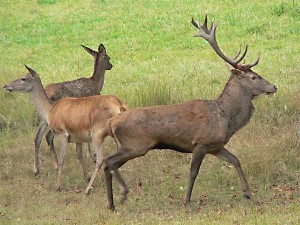
mountains, while pine and larch are found in sandy soil. There are many species of ferns, flowers, fungi, and mosses. Wild animals include deer, wild boar, mouflon, fox, badger, hare, and small numbers of beavers.
The national parks in Germany include the Wadden Sea National Parks, the Jasmund National Park, the Vorpommern Lagoon Area National Park, the Müritz National Park, the Lower Oder Valley National Park, the Harz National Park, the Saxon Switzerland National Park and the Bavarian Forest National Park. More than 400 registered zoos and animal parks operate in Germany, which is believed to be the largest number in any country. The Zoologische Garten Berlin is the oldest zoo in Germany and presents the most comprehensive collection of species in the world.